SafeClick – Phishing Detection System
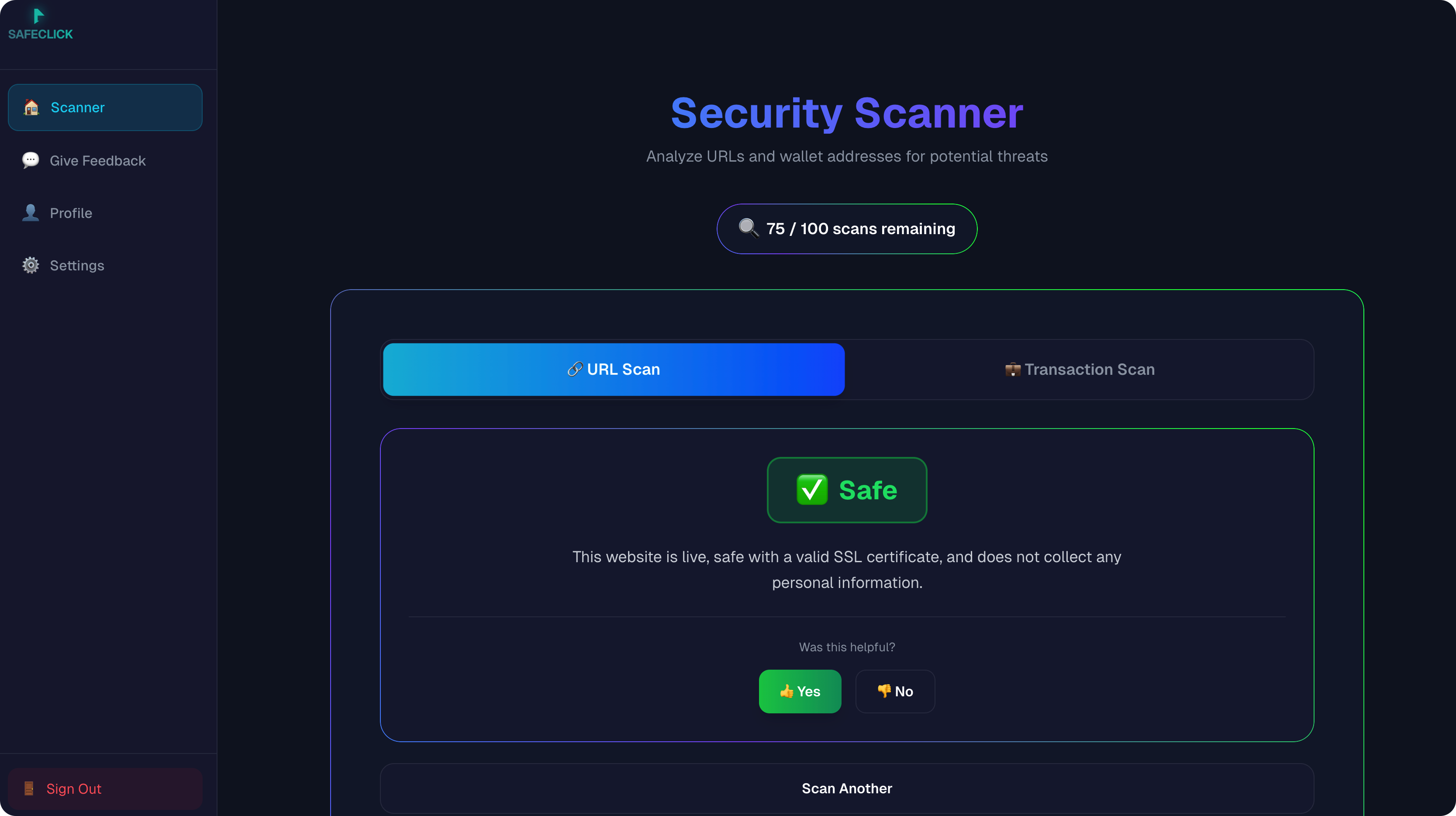
Deployed and live. Try it: https://safeclick.dev/ — serving production traffic with deterministic validation and human-in-the-loop–ready structured reports.
Demo
🏗️ System Architecture
graph TD
    A[User Input: URL / Tx Memo] --> B{Entry Layer / Router}
    B -->|Bypass/Cache| C[(Domain Reputation Cache)]
    B -->|New Scan| D[Multi-stage AI Pipeline]

    subgraph "AI Agent Pipeline"
    D --> E[Stage 1: Heuristic & LLM URL Analysis]
    E --> F[Stage 2: Sandbox & Evidence Collection]
    F --> G[Stage 3: Final Reasoning & Verdict]
    end

    G --> H[Deterministic Logic Layer]
    H --> I[Output: Structured JSON Report]
    C --> I
Problem
Traditional ML or LLM-only approaches fail in phishing detection due to sparse signals, zero-day variants, and unreliable external evidence. Users need a security-focused system that operates under real-world constraints. SafeClick bridges the gap between unreliable AI outputs and mission-critical security by applying a zero-trust stance: LLM outputs are never trusted until they pass explicit validation boundaries and deterministic scoring.
Approach
- Designed a multi-stage phishing detection pipeline for URLs with constrained LLM reasoning and deterministic risk scoring
- Implemented deterministic security logic to ensure stable verdict behavior in non-deterministic model environments
- Treated the LLM as a probabilistic component behind explicit validation boundaries, caching/deduplication, and fallback logic
- Engineered for reliability under degraded dependencies with clear failure modes and cost control
- Evolved a hackathon prototype toward a production-ready security service with system boundaries and observability
Web3 & Blockchain Security
The system treats transaction memo phishing as a first-class threat vector. Attackers send micro-transactions (e.g. 0.000001 tokens) with malicious URLs embedded in the memo field, targeting wallet users who click without verifying. SafeClick’s pipeline treats the memo as an input vector: extracted URLs are fed into the same AI-driven URL scanner and deterministic logic layer, so Web3 users get the same structured risk report whether they paste a URL or submit a transaction memo. This bridges traditional web phishing and on-chain social engineering in one pipeline.
Engineering Highlights
| Feature | Implementation | Benefit |
|---|---|---|
| Deduplication | Firestore Transaction-based ScanJobs | Prevented 40% redundant LLM calls |
| Caching | Two-tier: Bloom Filter + TTL Firestore | Reduced latency by ~200ms for known domains |
| Reliability | Pydantic Schema Validation | 0% output format error rate |
| Testing | 38+ Unit & Integration Tests | Ensured safe fail-over for insufficient evidence |
Results
- Deployed at safeclick.dev — serving production traffic with structured risk reports for URLs and transaction memos
- Won 1st Place and Most Secure Project Award (Hofstra-Pensar Hackathon)
- Reduced nondeterminism in decision outputs through deterministic scoring and validation boundaries; 0% output-format error rate in production
- Improved resilience to partial failures via explicit fallbacks and pipeline-stage fault handling
Tech Stack
Python, Pydantic, LLM orchestration, multi-stage URL analysis, caching, deduplication